

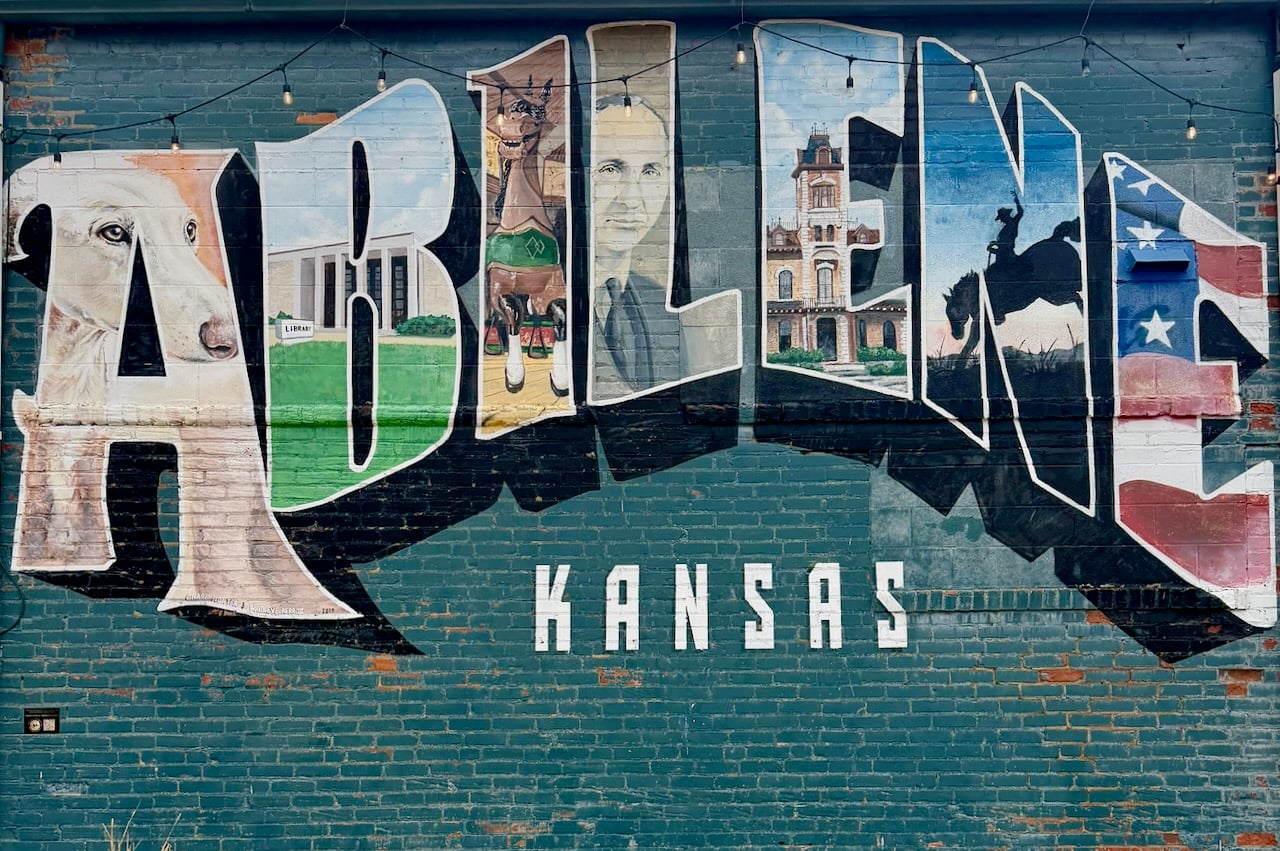

Editor’s Note: This post is written by a member of LTV’s sponsored content team, The Leisure Explorers. Do you own a Leisure Travel Van and enjoy writing? Learn more about joining the team.
Little Ike Park sits in Abilene’s historic downtown, a green pocket across the street from Hickok’s Bar. On our first afternoon in town, we drove there to snap photos. That’s when a black pickup with a crash guard on the front bumper, veteran commemorative plates on the back, rolled up to the curb.
A man dressed head to toe in jet-black leather with silver hair down to his shoulders, sporting a mustache straight off a Wild Bill Hickok tintype, steps out of the truck and walks into Hickok’s Bar.
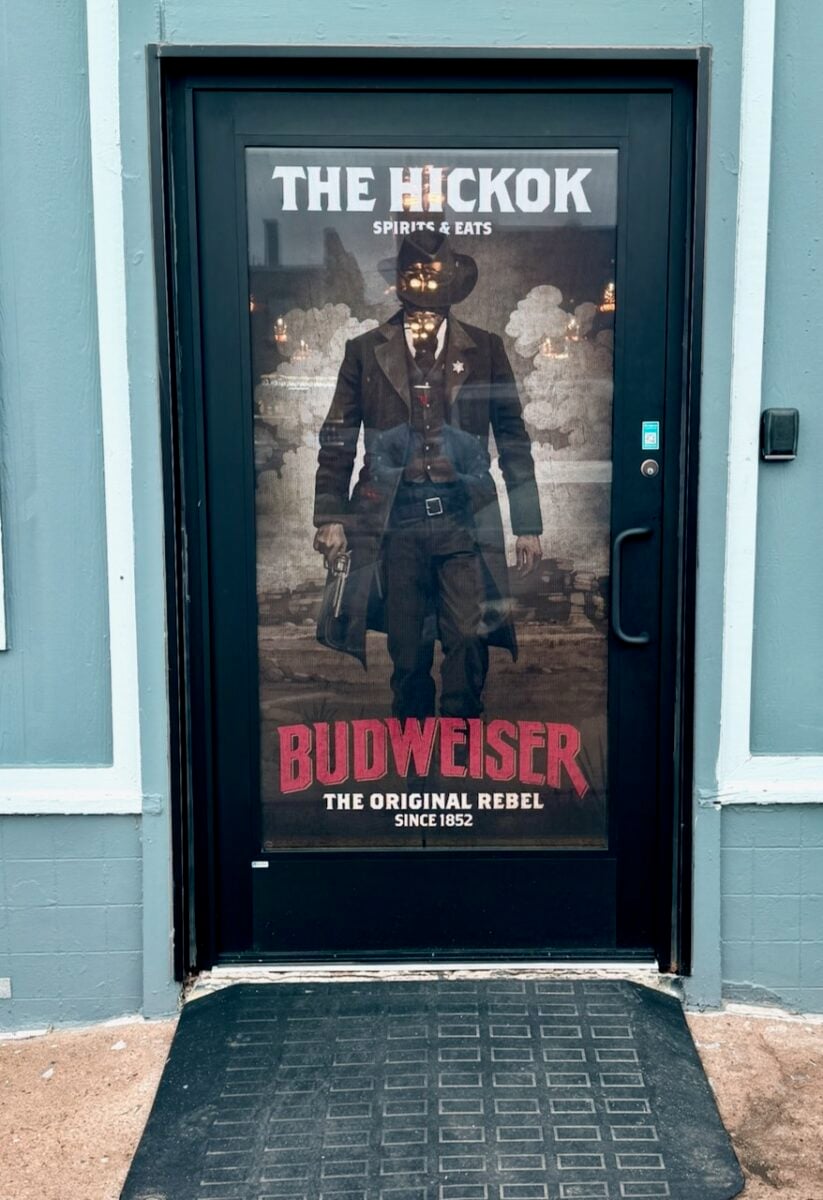
Was this guy the owner of the bar? Perhaps he is a descendant of Wild Bill? Or maybe he is a regular customer? We had to know.
A stroll into the bar and a moment of direct eye contact with the man sitting alone with his beer suggested all we needed to know. His expression? Leave me alone. The opening seconds were tense but calm. A terse exchange loosened up when a conversation about American veterans stood as a common link. As it turns out, he was not a Hickok descendant, did not own the bar, and simply stopped by for a beer in a bar named for a legendary cowboy he happened to resemble.
That encounter turned out to be typical of Abilene. It’s a small town that keeps surprising travelers with unexpected finds.
Abilene, Kansas, has topped best small-town-in-America lists for the better part of a decade. These citations suggest Abilene is worth a visit, but in and of themselves, do not say why.
The answer lies closer to our late-afternoon encounter at Little Ike Park, where three notable American stories converge on one Kansas street: a President’s boyhood home, a Gilded Age mansion, and a museum that presents the greyhound story in America. Discovery, in the end, is the reason to visit Abilene.
Arrival: The Sound of a Plains Town Announcing Itself
First, the flags. American flags line the street at set times of the year, rotated on and off with the seasons in a rhythm the town knows by heart. During the Christmas holidays, Buckeye Avenue and NW 3rd Street transform into “Christmas Tree Lane”, with the city setting out small cedar trees along the corridor and residents stepping outside to decorate them. Yes, this is a patriotic Midwestern town and proud of it. After all, it is the hometown of the 34th President of the United States.
Second, the trains. You’ll see them stationary along the tracks downtown, awaiting their next task. Abilene was the end of the Chisholm Trail, and cattle by the hundreds of thousands moved through the town by rail during the cow-town era. The trains still run today, and their whistles cut across town at odd hours of the afternoon and evening. A driver heading one block over may find himself stopped at a crossing by a freight train right in the middle of the town.
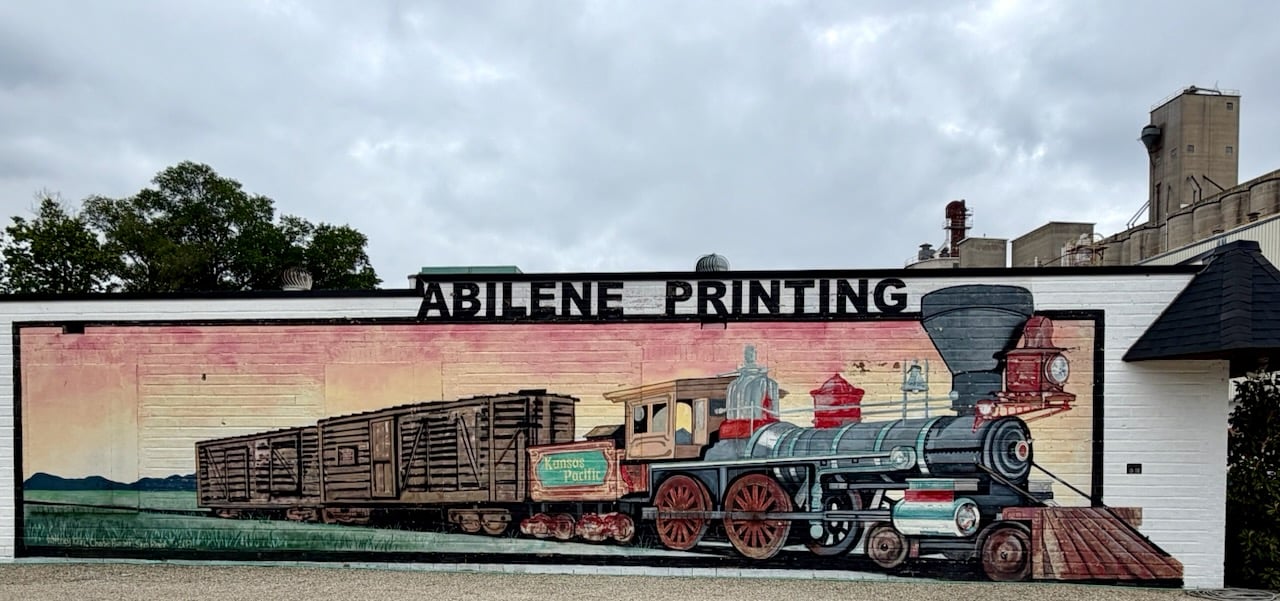
Third, the siren. From April through October, the town’s tornado siren runs a test at noon on Tuesdays. Every Plains town in America sounds one, and if a visitor happens to be standing on the sidewalk when the sound lifts, it serves as a reminder that this part of the country takes its weather seriously.
The Boyhood Home That Changed the Twentieth Century
Three notable sites anchor Abilene, and all of them changed America. The first sits at 225 N.E. 4th Street: the Eisenhower Presidential Library and Museum, a campus spread across twenty-two acres in town. On the grounds stands the small house where Dwight D. Eisenhower grew up long before commanding Allied forces in Europe during World War II, directing the D-Day invasion—the largest amphibious assault in history, and later serving as the 34th President of the United States.
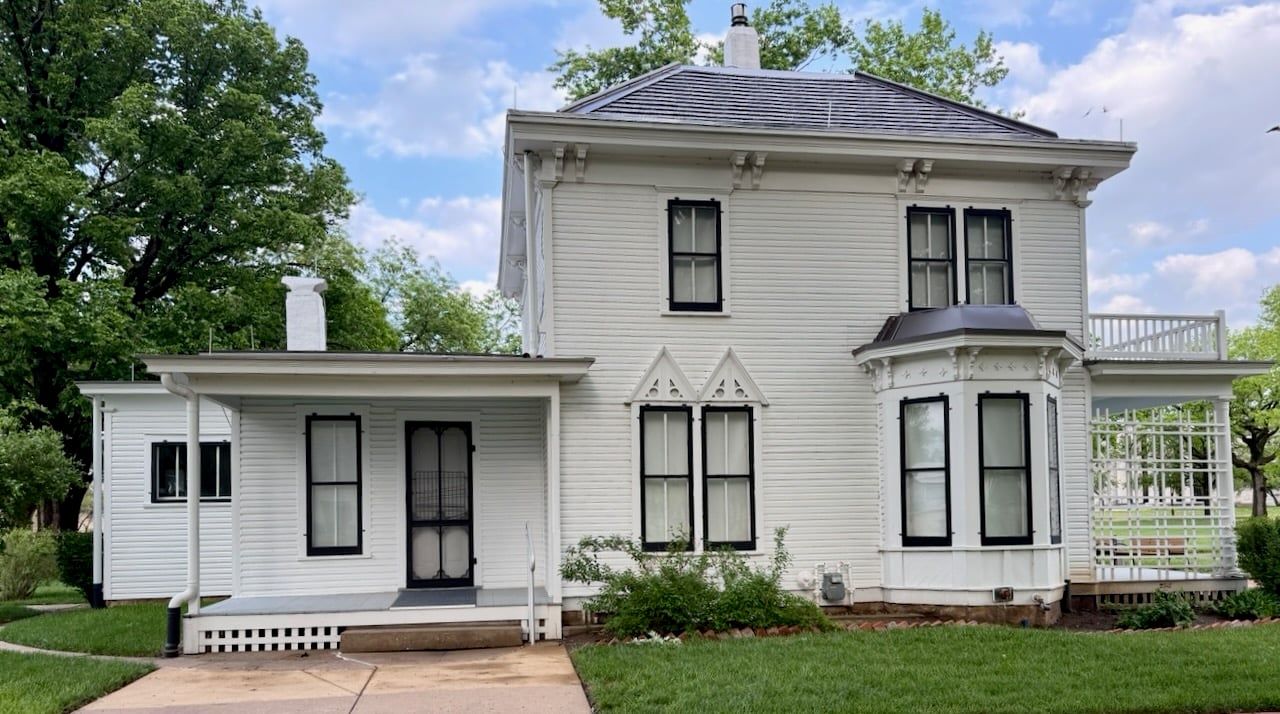
The Eisenhower campus is not one building but several: Ike’s childhood home, a museum, a library, and a chapel. A visitor’s center with a store is adjacent to a large parking lot.
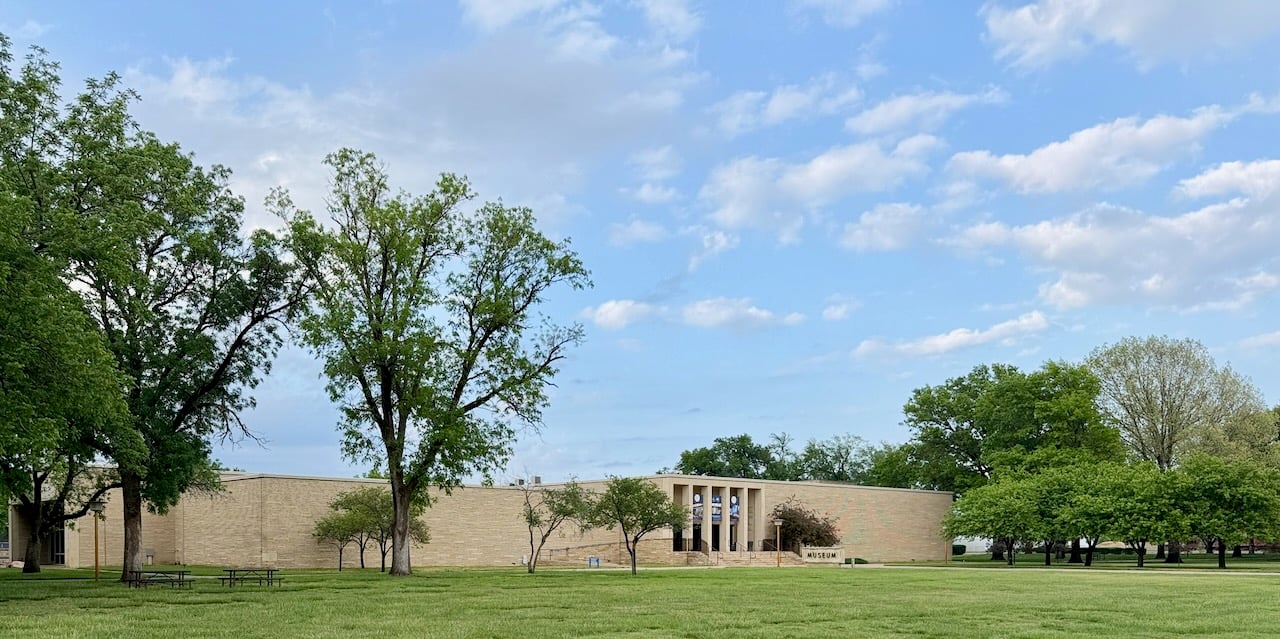
Eisenhower’s boyhood home anchors the campus. The museum next door walks visitors through Eisenhower’s life in careful chronology: the small-town beginnings, the West Point years, the Louisiana Maneuvers, the D-Day command, the postwar military governorships, and the eight years in the White House. World War II memorabilia fill the exhibits, and for any traveler drawn to twentieth-century American history, the campus rewards a full afternoon of exploration.
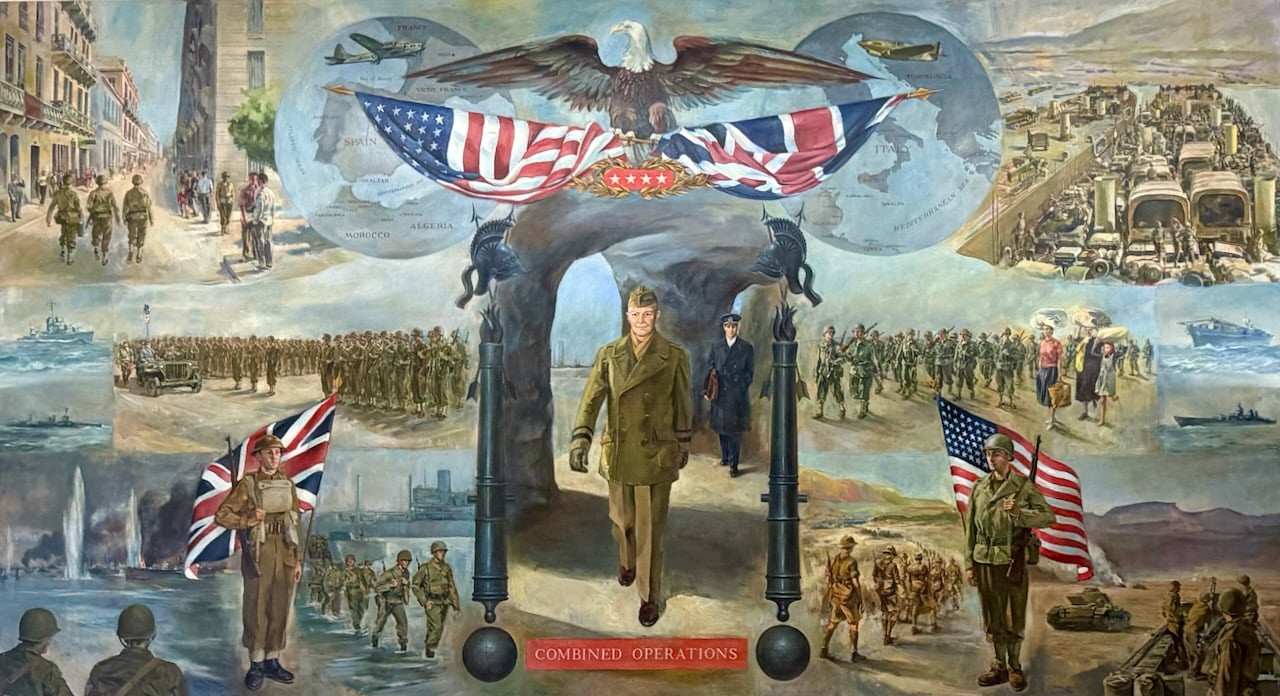
The Eisenhower Museum weaves a narrative through its artifacts rather than sorting them into categorical displays—a nice touch that sets it apart from museums that simply sort artifacts by category.
The library is a working research institution rather than a public destination, and scholars travel here from around the world to work for months at a stretch, deep in the archives. Casual visitors do not spend much time inside the library’s doors, as it is the museum and the boyhood home next door that visitors frequent.
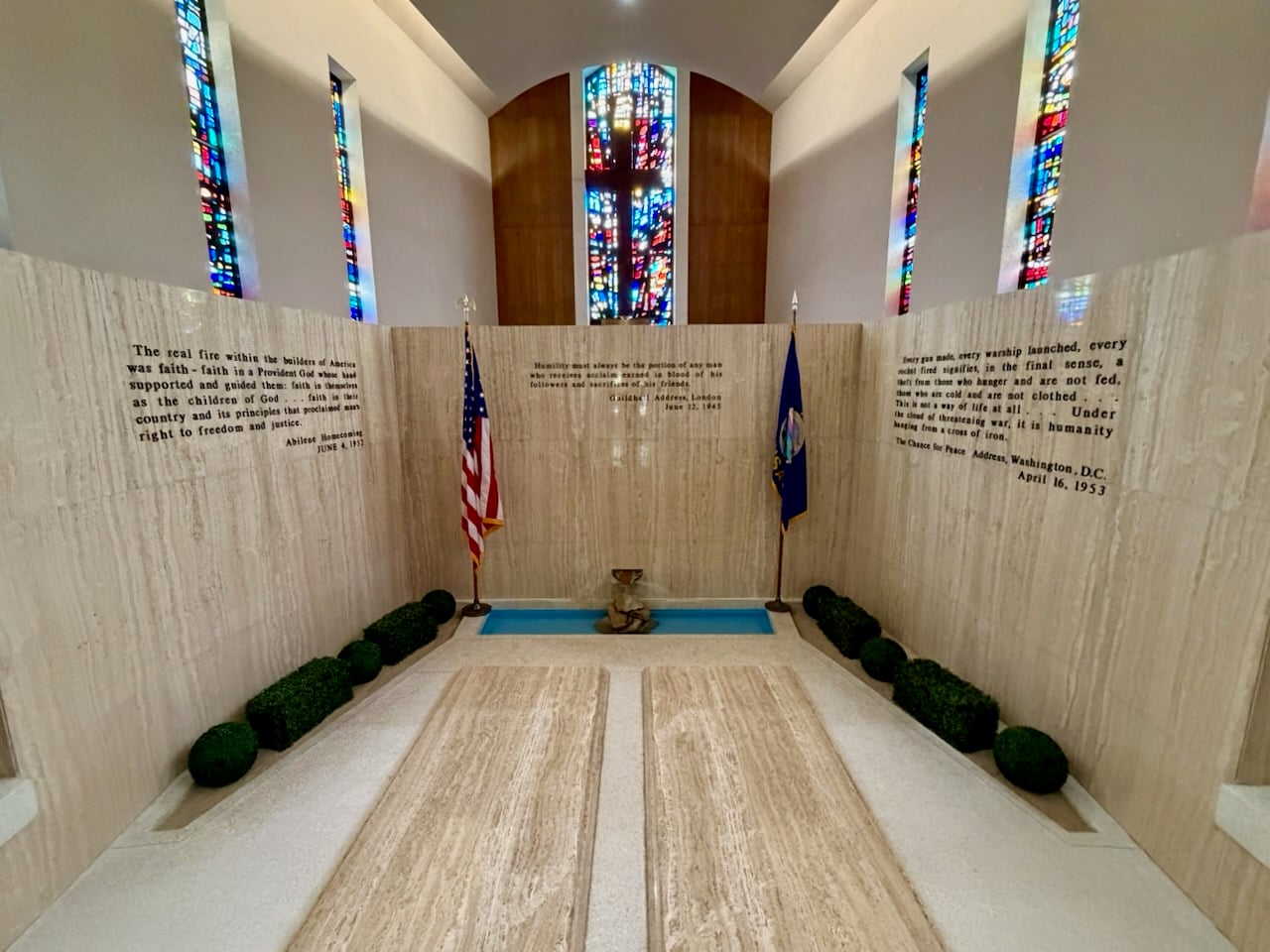
A chapel on the grounds contains the caskets of Eisenhower and his first lady, Mamie, and their firstborn son, Doud, who succumbed to scarlet fever at the age of three.
A Gilded Age Mansion with Furnishings from a World’s Fair
The second story in town is an historic home that sits a mile north of the Eisenhower Campus at 1105 N. Buckeye Avenue: the Seelye Mansion. Visitors drive here from downtown rather than walk because of the distance from the Eisenhower campus and the historic downtown.
Kansas has designated the mansion one of its eight architectural wonders. When A.B. Seelye built the 11,000-square-foot house in the early twentieth century, he spent $55,000 on construction and then traveled to the 1904 St. Louis World’s Fair to buy the furnishings for it. The furnishings cost more than the house itself.
Seelye was a patent medicine magnate long before the industry became well known as “Big Pharma” as the public sees it today. He invented, built, and sold medical devices and medicinal products across the Midwest and was a contemporary of the other patent medicine operators of his era, though his business never scaled beyond regional operations.
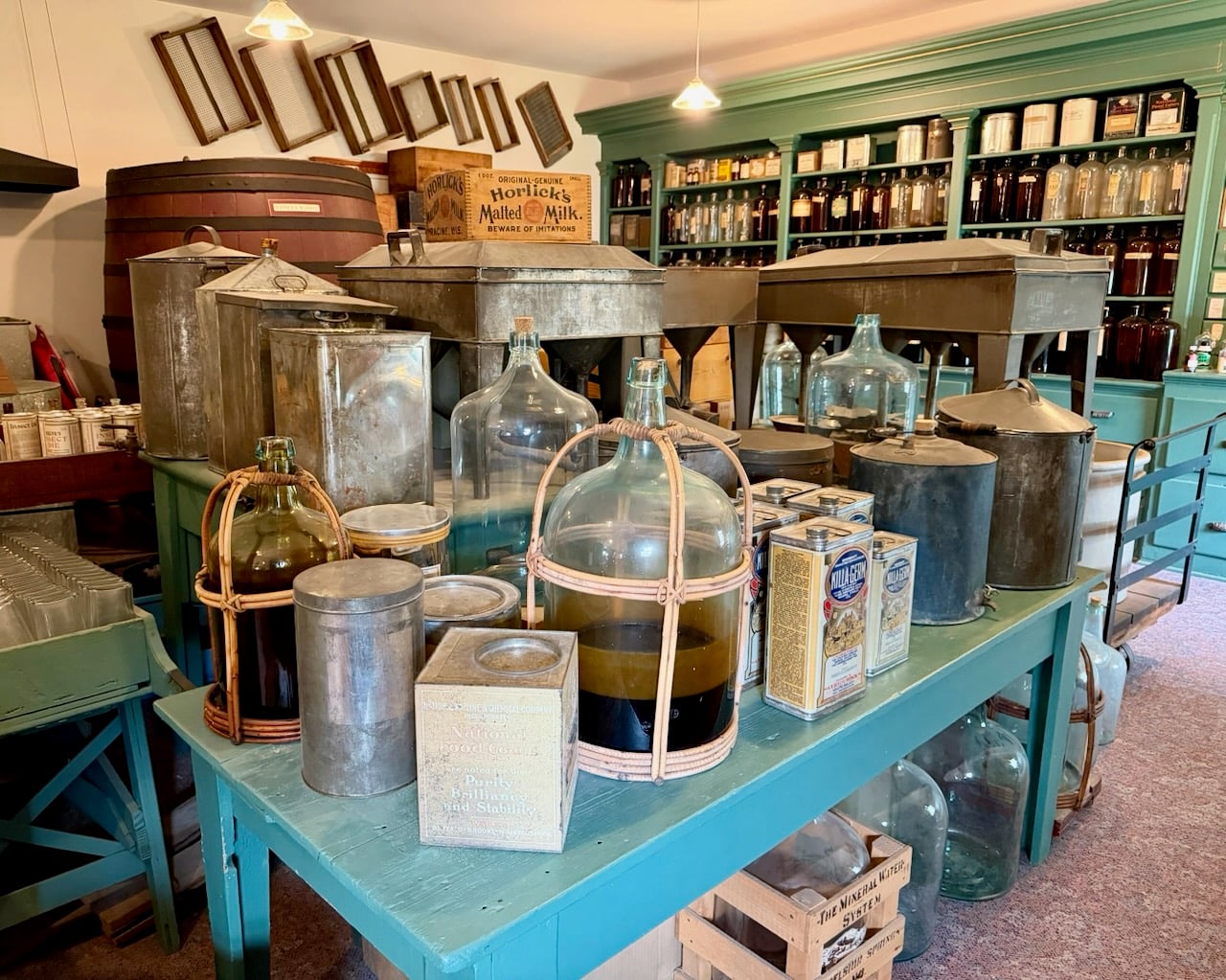
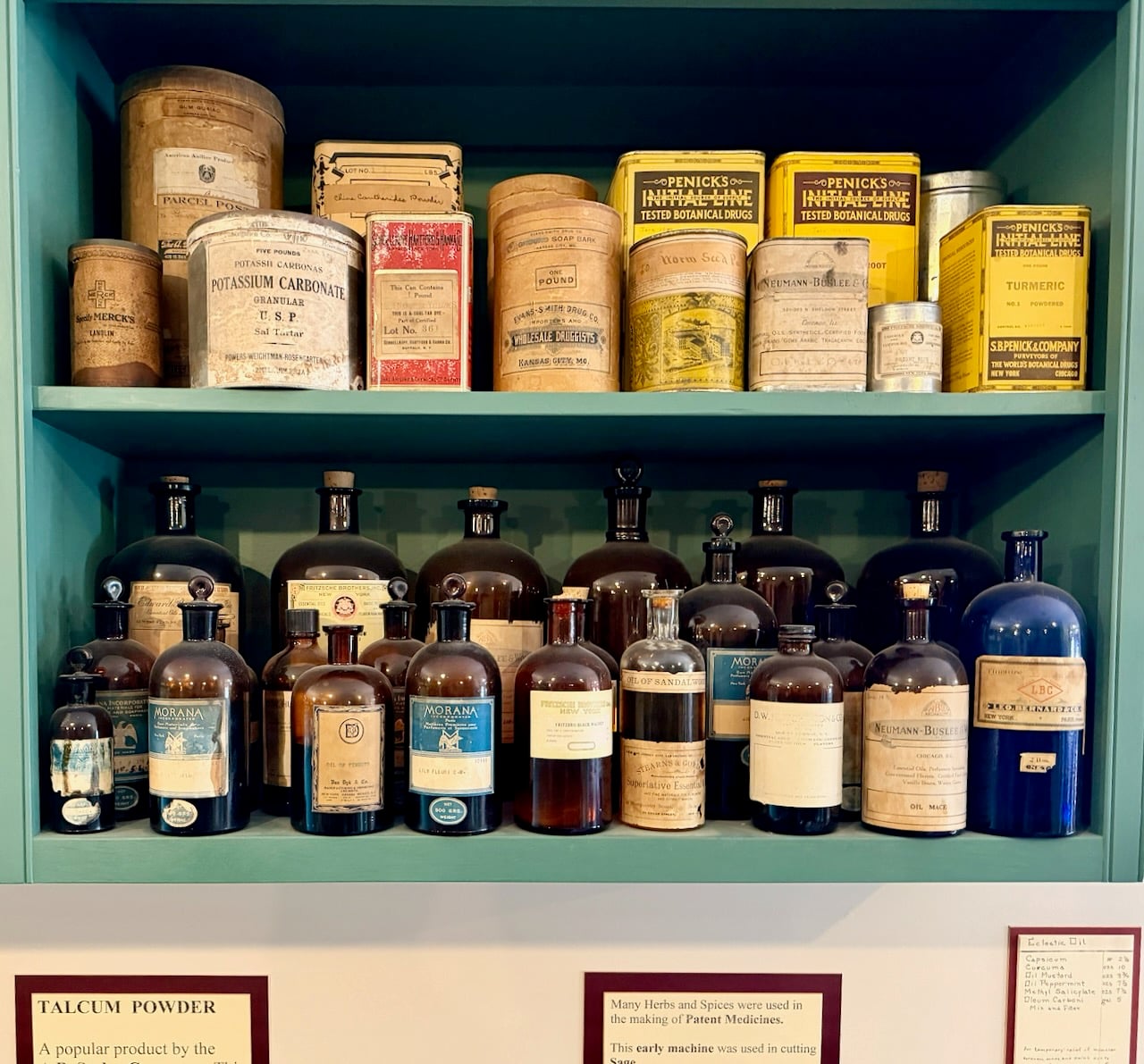
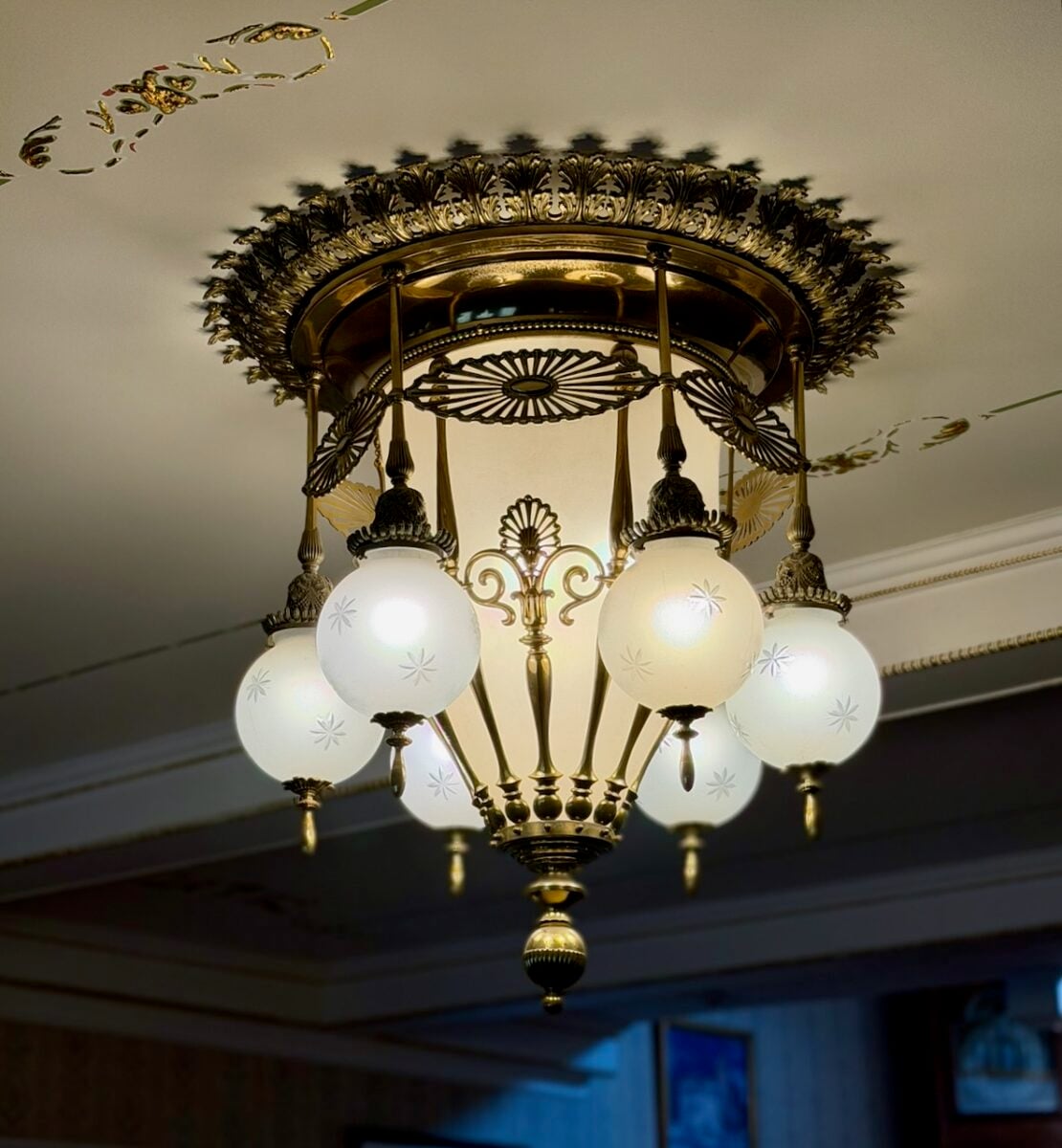
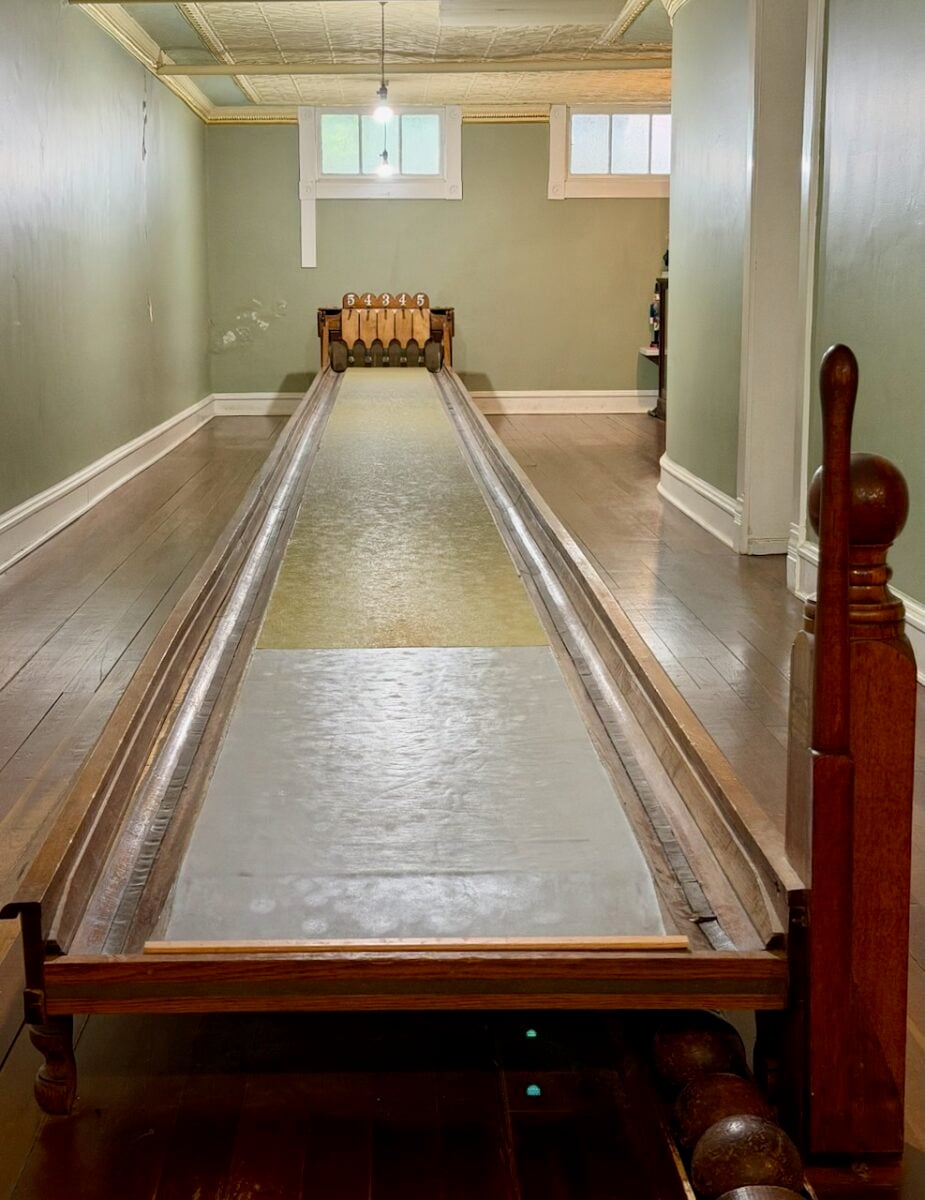
Inside the mansion, most of what a visitor sees is original. Edison light fixtures are throughout. A Tiffany-style mantle anchors one room. A 1904 Box Ball Alley purchased at the 1904 World’s Fair still stands in the basement, where visitors are welcome to bowl a game. This Box Ball machine is the only original machine from its era in existence in America today.
Frank Lloyd Wright, passing through in the 1920s, suggested an interior remodel. He designed custom furniture for the mansion, much of which is still on site and used by guests today.
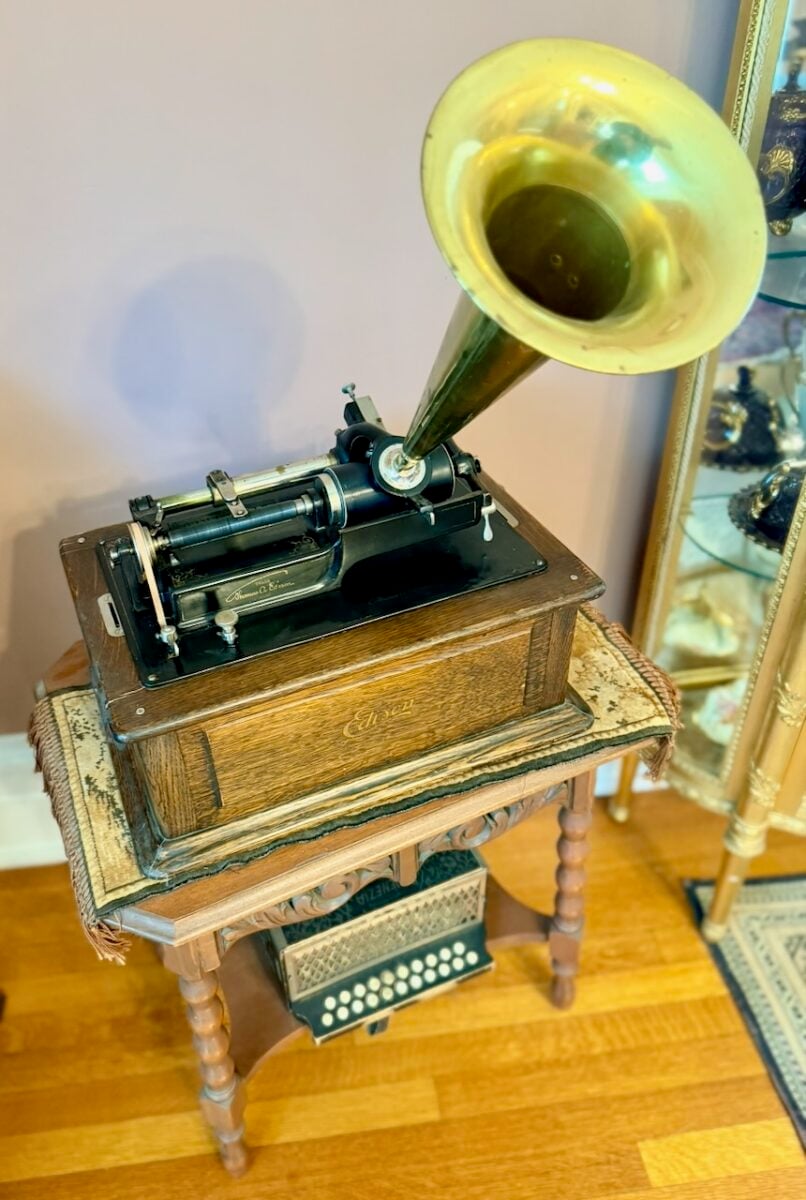
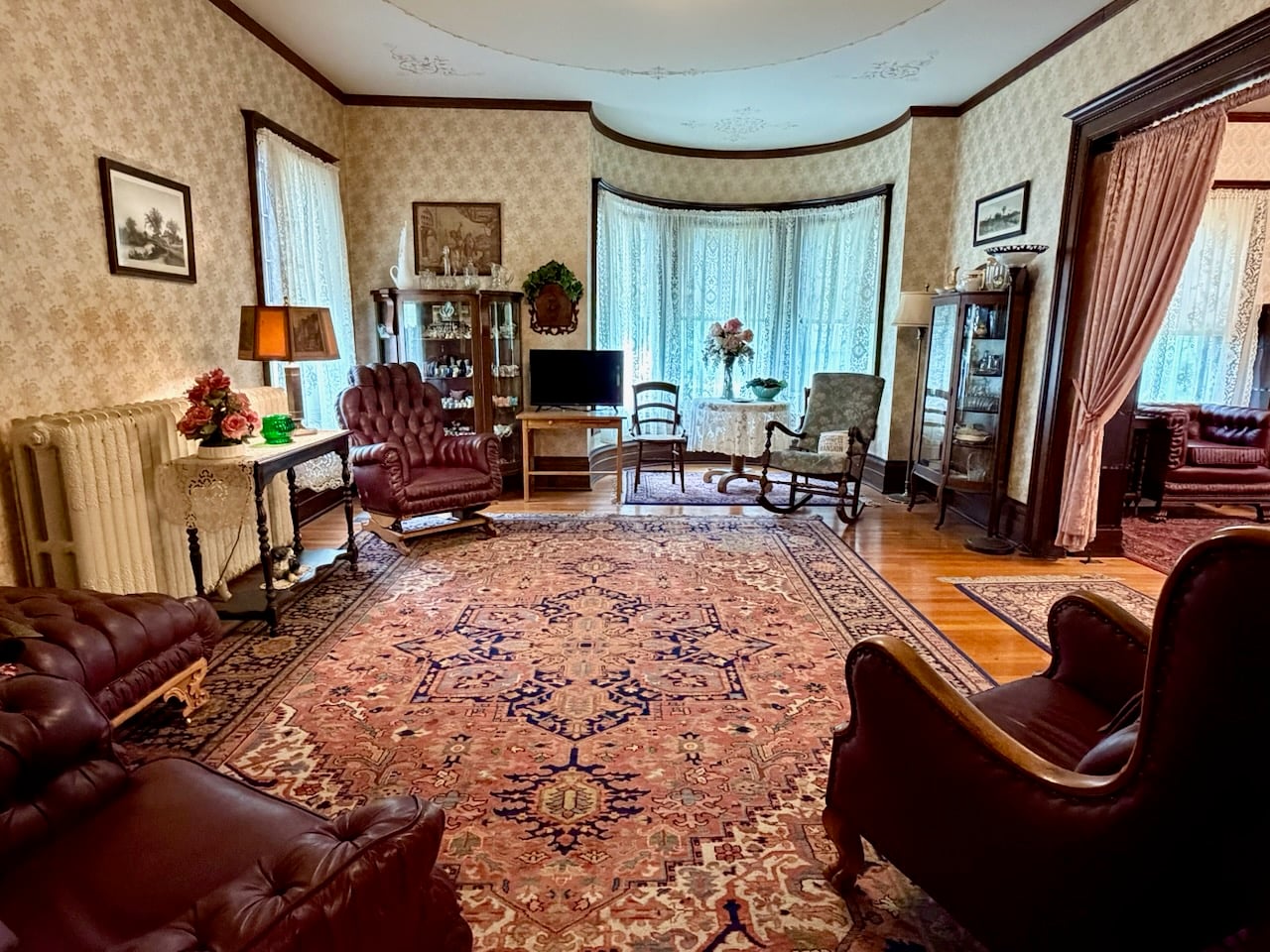
The Seelye Mansion was featured on the History Channel’s Mysteries at the Mansion. This home is a living, open museum. You can sit in furniture and touch items. Very little in the home sits behind or is encased in glass.
But the real reason to walk through the front door of the Seelye Mansion is Terry Tietjens. Tietjens is in his late 80s and owns the mansion, buildings, and grounds. He runs the on-site museum and the A.B. Seelye family archives. He bought the home from Seelye’s two surviving daughters many years ago, on the condition that he would preserve and present their father’s legacy accurately, and that the two sisters could live in the home until they died—both promises were kept.
A conversation with Terry is priceless. He is a musician, a historian, an archivist of the Seelye family, and one of the more remarkable individuals a traveler is likely to meet on any stretch of I-70. His anecdotes about A.B. Seelye, the daughters, and his own life, told through music, history, and preservation, are worth the visit.
Terry plays multiple musical instruments. Inside the mansion, you’ll note a Steinway & Sons grand piano and an organ, both of which Terry plays for guests unprompted.
The Seelye family holds annual reunions, and of course, Terry is usually present at these events. On one occasion, a family reunion in Utah involved a visit to the Salt Lake Tabernacle. Upon learning of Terry’s accomplishments as an organist, the resident organist at the Tabernacle invited Terry to play the organ for the Seelye family. For Terry, this stands as one of many highlights of his long life.
Put the Seelye Mansion on your must-visit list. It’s not just a building. It presents the remarkable story of American innovation, achievement, and early-20th-century family life in a Gilded Age cloak.
A Museum That Chronicles the Greyhound Racing Story in America
Back on the south end of Buckeye Avenue directly across the street from the Eisenhower campus, sits our third American story and one of the most distinctive museums in the American interior: the Greyhound Hall of Fame.
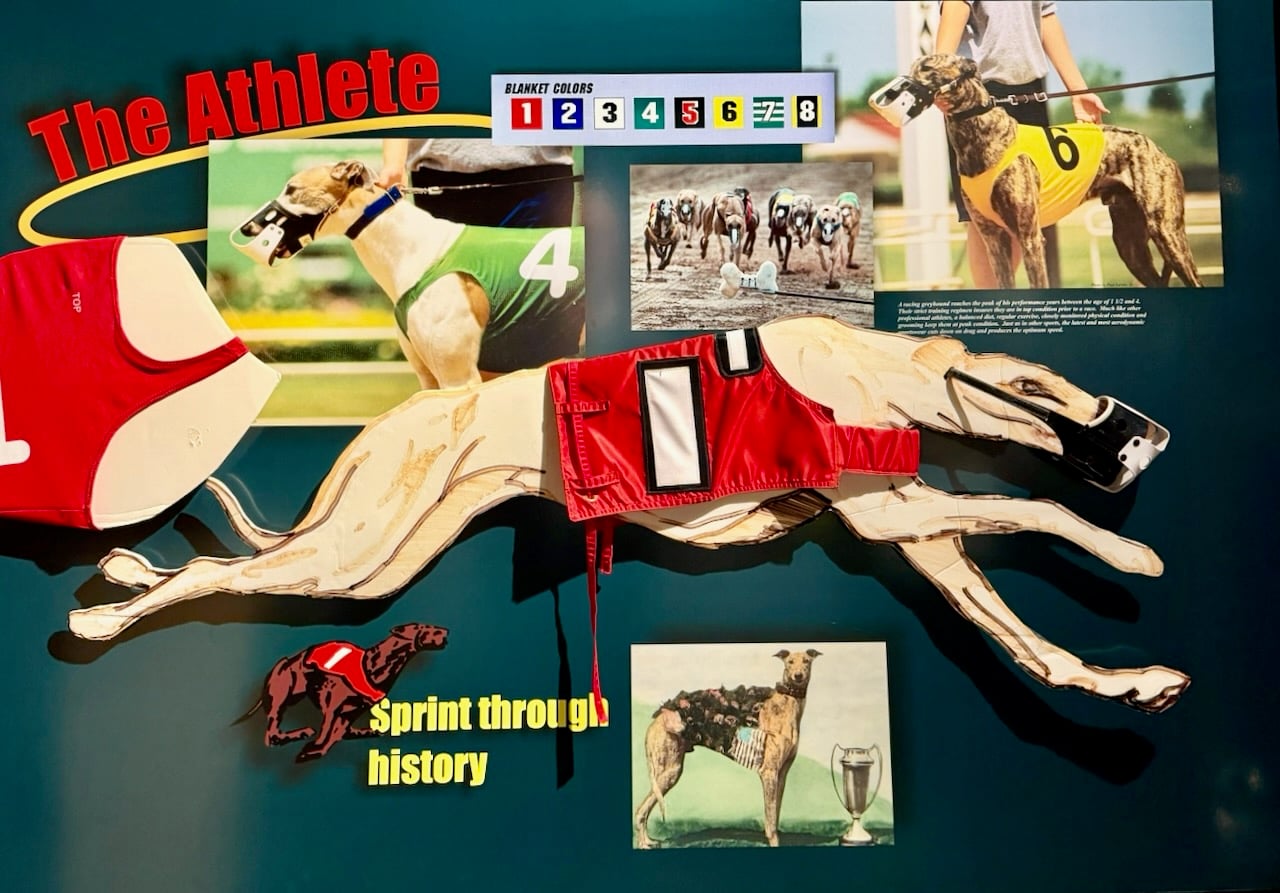
At the door, a greyhound and its owner greet visitors. Inside, the walls present photographs of racing dogs, their owners, the tracks that once dotted the country from coast to coast, and every notable figure going back to the sport’s earliest recorded history.
Many racing greyhounds born in the United States are registered here in a filing system with no equivalent elsewhere. Atlas Obscura cited the museum on its Ultimate List of Wonderfully Specific Museums.
Owen Patrick Smith, the inventor of the mechanical lure, made racing greyhounds on an oval track possible. You’ll see this lure in the museum. You’ll also see tote boards, tabulating machines, and learn about the history of pari-mutuel betting and how dog racing became popular in the United States.
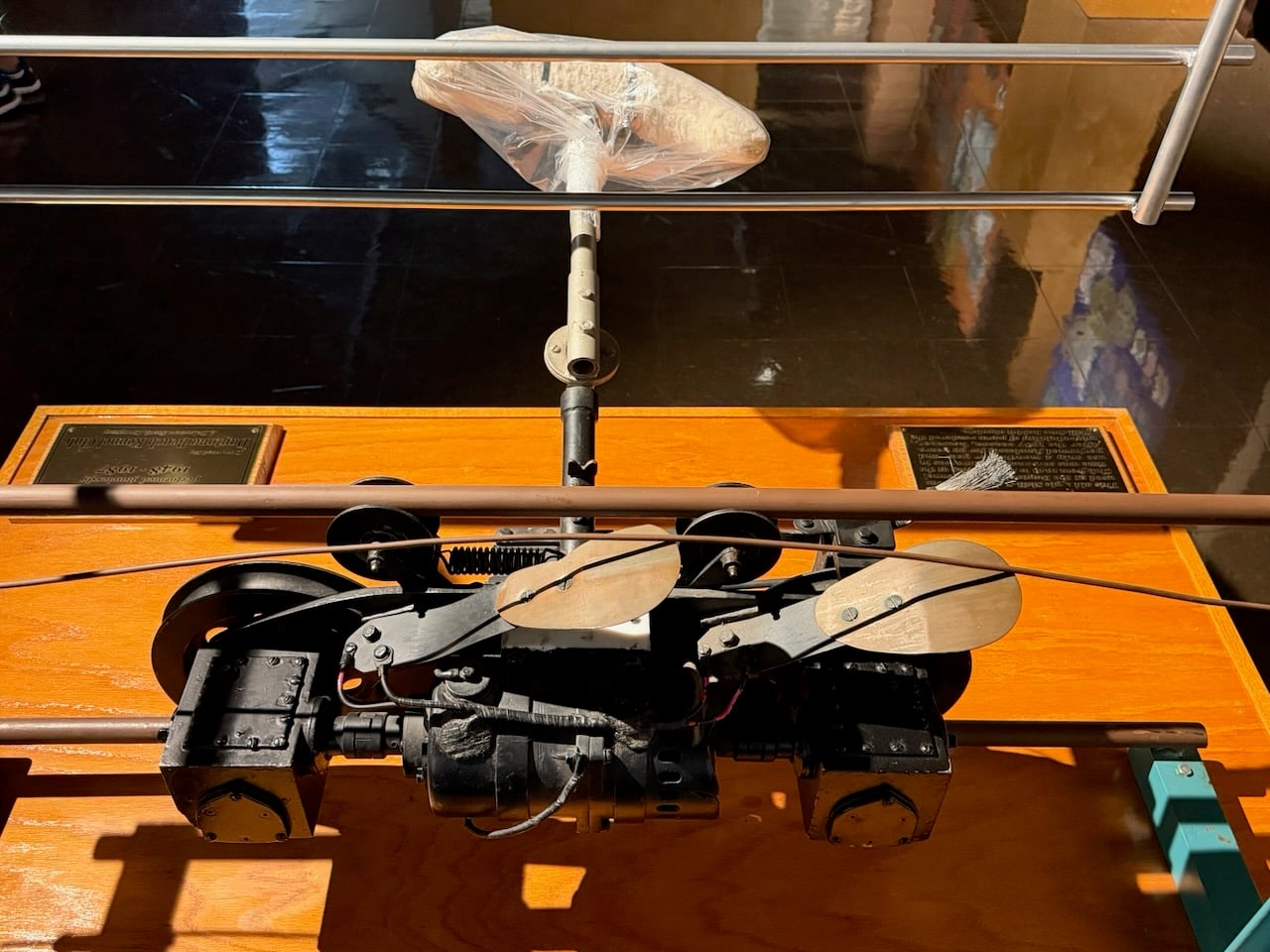
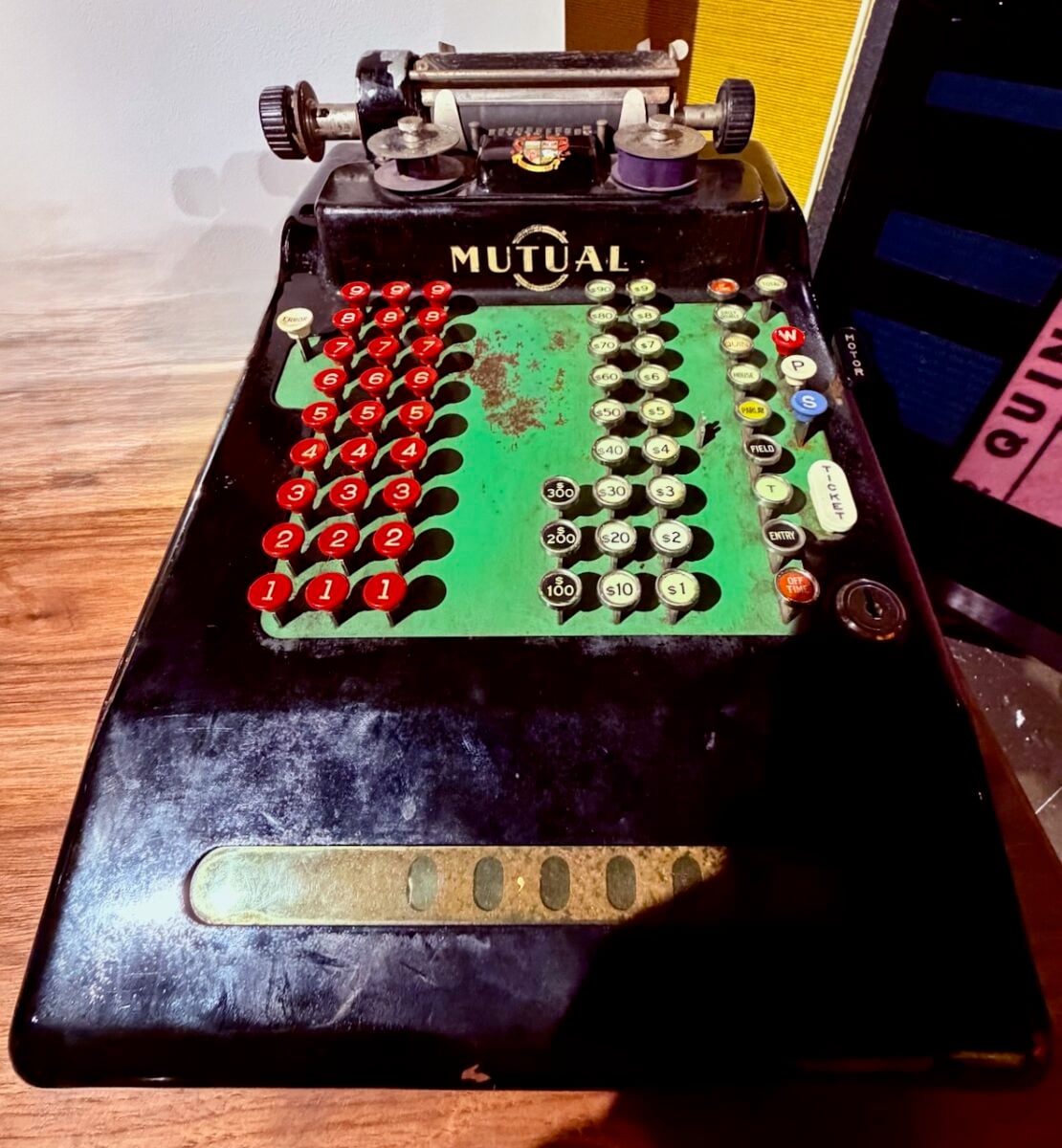
The range and depth of the greyhound history cataloged here is extensive enough to reward most visitors. If you love dogs or find the history of dog racing in America interesting, this museum is a must-see destination.
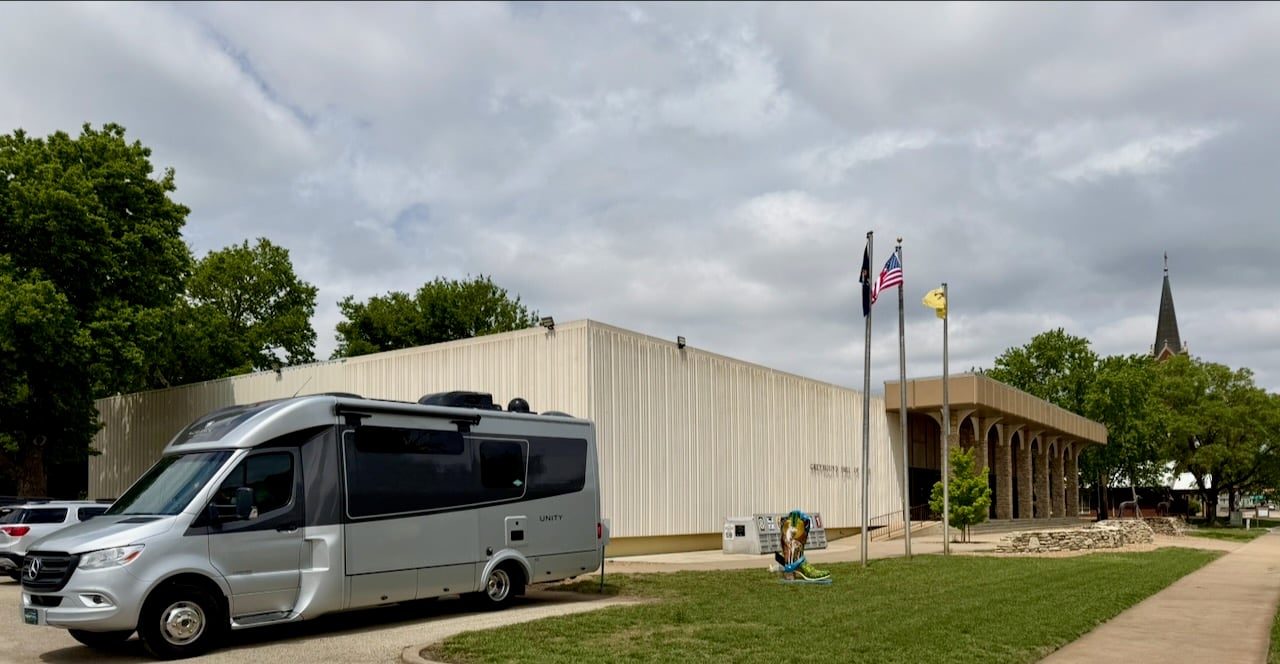
Where To Eat
Where do you eat in a town of about 6,500 people? The answer is, at the same places the locals eat.
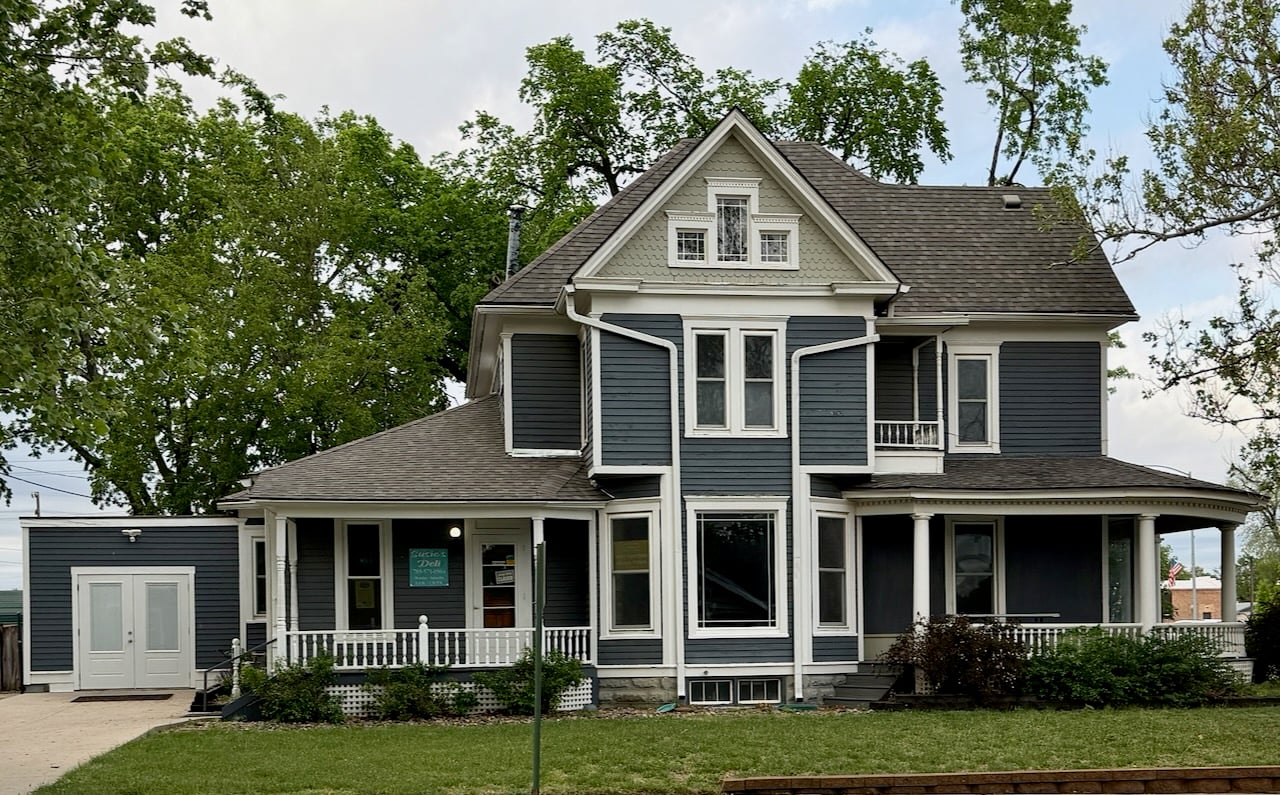
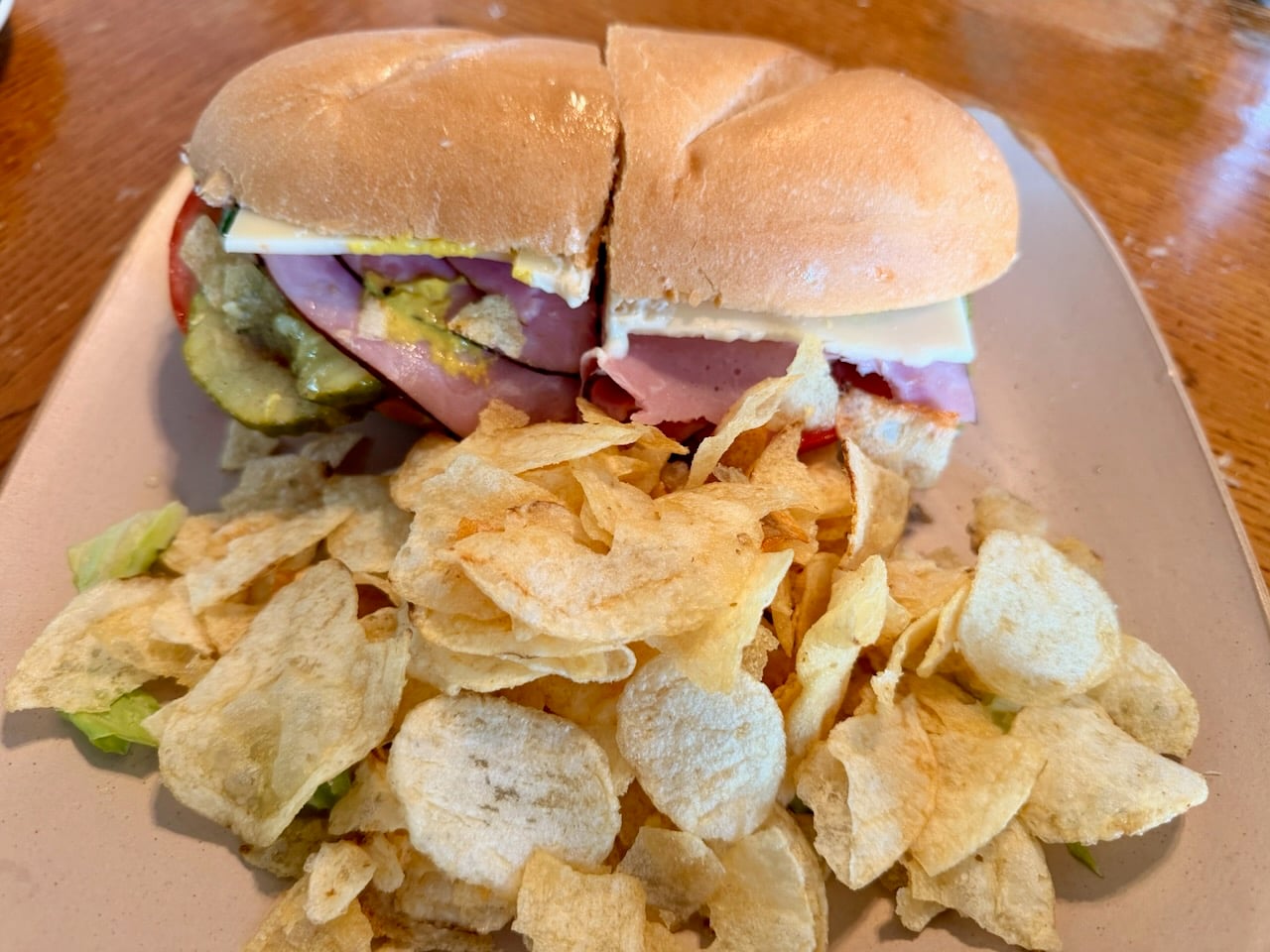
For breakfast or lunch, Susie’s Deli at 102 N. Buckeye Avenue is the local recommendation the Convention and Visitors Bureau offers first. It sits in a restored historic home downtown, a short walk from the Eisenhower campus, and the proprietor runs the place herself. A ham sandwich there is generous and satisfying—the kind you just don’t find at a chain, and a taco salad is fresh and well composed. Chips come with both. The service is personal, and the interior of the restored house carries genuine character over corporate polish. As one visitor summed the place up: “Simple food done right is an art form, and Susie’s has mastered it.”
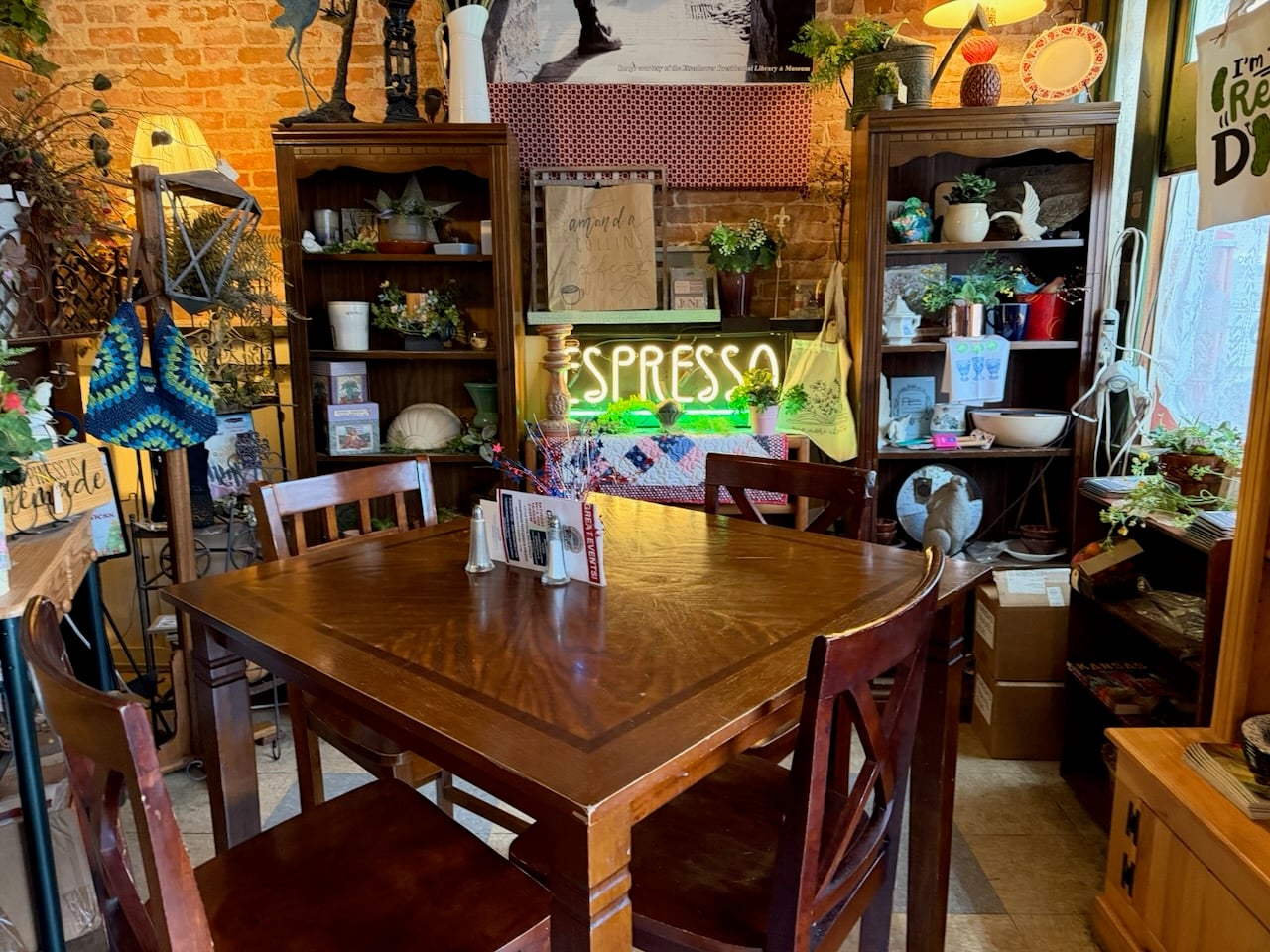
Amanda’s Bakery & Bistro at 302 N. Buckeye Avenue rates even higher—a straight five out of five per our experience with a tourist-oriented novelty-shopping side in the same space. We stopped in for coffee and a pastry. This place is akin to a Cracker Barrel experience, with novelty items for sale, all focused on one consistent theme: all things Abilene.
For dinner, Saddles and Spurs at 2309 N. Buckeye Avenue is the moderately priced spot the locals frequent. This is a solid workhorse restaurant where you’ll find locals rather than a special-occasion touristy stop. If the locals go here, chances are travelers will like it too—we did!
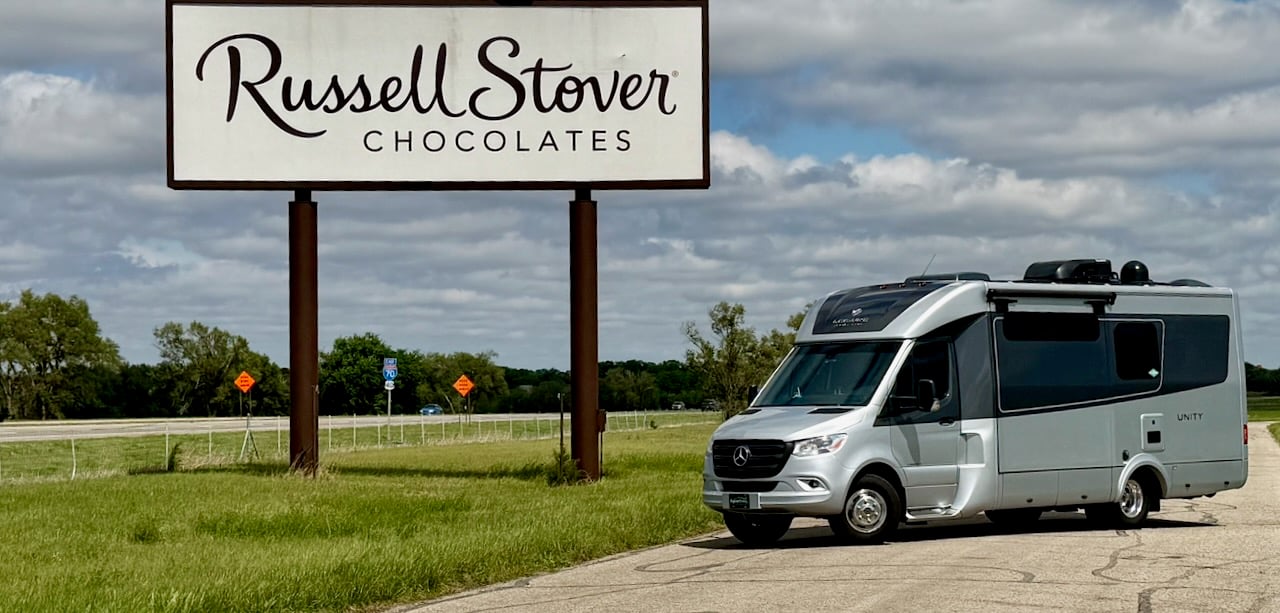
Sweet-tooth lovers will be happy to learn there is a Russell Stover Factory Store at 1993 Caramel Blvd. Truckers, RV travelers, and those with vans and station wagons load up their vehicles with sweet delights after shopping in the showroom. Some of the visitors, by appearance, are clearly regulars.
In the back of the factory store is a bargain-hunters area where deals on unsold sweets from previous holidays are available at low prices. You’ll also find an ice cream fountain at the check-out counter.

Where To Stay
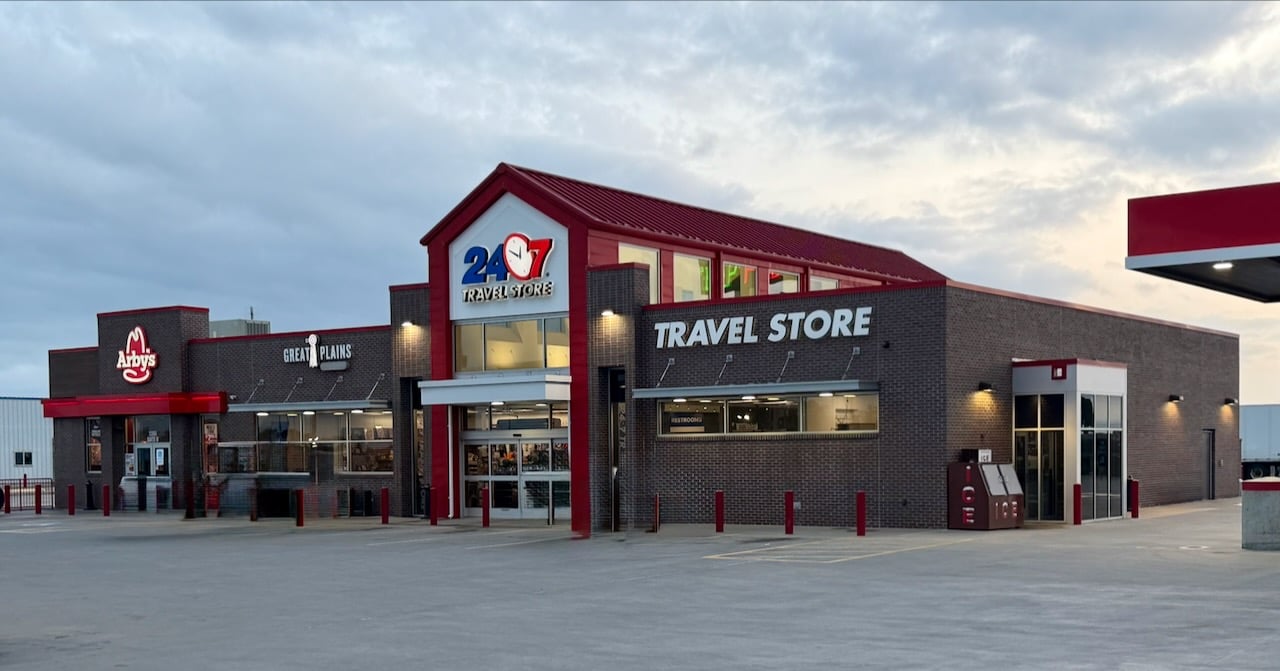
Flatland RV Park sits right off I-70 on N. Buckeye Avenue on the way into town. The sites are level concrete—the kind of level that lets a driver set a coffee mug on the counter and walk away for the day. The RV area sits behind a chain-link security perimeter set beside a 24/7 convenience store, and check-in runs around the clock through the store attendant, so late arrivals do not have to wait for a morning office to open. The pads at this park are large enough to accommodate pickup trucks hauling long fifth-wheel trailers. From the RV park, downtown Abilene is only a five-minute drive.
When to Visit
Abilene is a small town in the middle of wide-open spaces that you can visit year-round. There’s plenty of on-street parking in town. The Eisenhower complex offers a large parking lot across the street from the Greyhound Museum. You’ll also find parking spaces behind and around the Seelye Mansion.
So, pull off I-70 at exit 275, level your LTV at Flatland, and drive up Buckeye Avenue. Park at the Eisenhower campus and stand where a boy from a Kansas cow town grew up before he ran D-Day and then the country. Drive north to the Seelye Mansion and let Terry Tietjens tell you the story of the house he saved and the history of a bygone era that is still accessible to those with a curious streak. Cross Buckeye to the Greyhound Hall of Fame and meet a greyhound at the door.
If a man in black leather steps out of a black pickup bearing veteran’s plates outside a bar named for Wild Bill, do what we did. Go strike up a conversation. If you do, you are likely to discover a novelty about Abilene we missed.
Acknowledgements
The authors thank Julie Roller Weeks of the Abilene Convention & Visitors Bureau for providing press pass access to sites and local area resources in Abilene.
You can read our companion story about Hays, Kansas, here.

Comments